The research of Porous Media for Climate Solutions enables efficient design and optimization of technologies to fight climate change, including preventing greenhouse gas buildup in the atmosphere by storing carbon dioxide in permeable underground geologic formations and in useful solid mineral forms.
Check out our research images below!

Laser-based Imaging Experiments
Porous Media Climate Solutions Lab Director Anna Herring is collaborating with Civil and Environmental Engineering (CEE) Assistant Professor Haochen Li and Psi Lab to understand mass transfer in the subsurface, for climate-positive technologies. She recently undertook a theoretical analysis to determine how diffusive transport will impact CO2 and H2 storage in geologic formations.
Porous Media Climate Solutions Lab Director Anna Herring is collaborating with Civil and Environmental Engineering (CEE) Assistant Professor Haochen Li and Psi Lab to understand mass transfer in the subsurface, for climate-positive technologies. She recently undertook a theoretical analysis to determine how diffusive transport will impact CO2 and H2 storage in geologic formations.

Microscopic gas bubbles
Understanding how gas (or supercritical fluid) flows and is trapped within the microscopic architecture of porous rocks requires some specky high-tech experimental techniques. Herring has used X-ray microcomputed tomography to visualize 3D fluid topologies, capillary pressure, flow patterns, and wettability characteristics. She has even used tomography to investigate how water is transported in soils under zero-gravity conditions and suggested a new way to grow plants in space.
Understanding how gas (or supercritical fluid) flows and is trapped within the microscopic architecture of porous rocks requires some specky high-tech experimental techniques. Herring has used X-ray microcomputed tomography to visualize 3D fluid topologies, capillary pressure, flow patterns, and wettability characteristics. She has even used tomography to investigate how water is transported in soils under zero-gravity conditions and suggested a new way to grow plants in space.

Solid, Mineralized Carbon
Carbon mineralization is a carbon utilization application where gaseous CO2 is storaged in mineral form.
Carbon mineralization is a carbon utilization application where gaseous CO2 is storaged in mineral form.
Bentheimer Sanstone
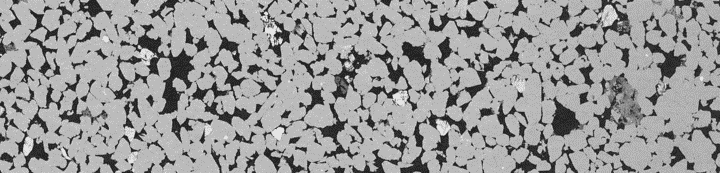
Bentheimer sandstone represents a model CO2 storage medium and we’ve used it for many visualized experiments. Like many sedimentary rocks, Bentheimer has a complex, multi-scale porosity and topology. We use topological data analysis to understand the influence of rock structure to trapping and transport.
Bentheimer sandstone represents a model CO2 storage medium and we’ve used it for many visualized experiments. Like many sedimentary rocks, Bentheimer has a complex, multi-scale porosity and topology. We use topological data analysis to understand the influence of rock structure to trapping and transport.